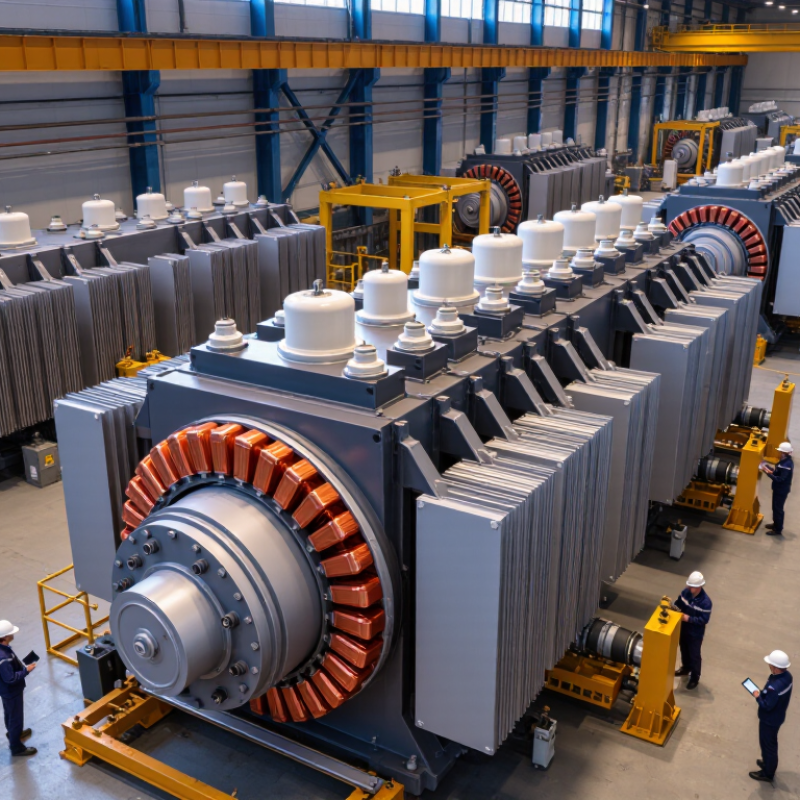
| Product Classification | IEC 60076-1; GB/T 1094 series | Clear identification of transformer type, rated power, voltage ratio, frequency, phase configuration, insulation system, cooling method, and service duty. | The technical specification should define all operating conditions before quotation and design approval. | Approved technical data sheet, nameplate drawing, general arrangement drawing, and design calculation summary. |
| Application Suitability | IEC 60076-1; project-specific furnace duty requirements | Design should address high starting currents, frequent load changes, short-circuit stresses, harmonics, thermal cycling, and possible phase-load imbalance associated with electric arc or resistance furnace systems. | The manufacturer should provide a duty-cycle study rather than sizing the transformer only from continuous furnace power. | Load profile, duty-cycle calculation, harmonic assumptions, short-circuit study, and application reference list without confidential customer data. |
| Rated Capacity and Voltage | IEC 60076-1; GB/T 1094.1 | Rated capacity and voltage levels must match the furnace, power-system fault level, incoming supply, secondary bus arrangement, and allowable voltage variation. | Voltage tolerance, impedance, vector group, tap range, and overload conditions should be stated numerically in the purchase specification. | Guaranteed technical particulars, voltage-ratio table, vector-group designation, and impedance test report. |
| Tap-Changing System | IEC 60214-1 for tap-changers; IEC 60076-1 | On-load tap changers may be used where continuous voltage regulation is required. Off-circuit tap links are suitable only when the transformer can be de-energized for adjustment. | The tap range, number of steps, switching duty, control logic, interlocks, and maintenance interval must be clearly defined. | Tap-changer type certificate, wiring diagram, control philosophy, routine test record, and protection/interlock description. |
| Cooling and Thermal Performance | IEC 60076-2; IEC 60076-7 for oil-immersed loading guidance | Cooling design should control winding hot-spot temperature during continuous operation, cyclic loading, overloads, and high ambient temperature. | Thermal design should include calculated temperature rise, cooling-stage control, fan or pump redundancy where required, and alarm/trip settings. | Temperature-rise test report, thermal calculation, cooling-system datasheet, fan-control logic, and overload capability statement. |
| Short-Circuit Withstand | IEC 60076-5; GB/T 1094.5 | Windings, clamping structures, leads, and connections must withstand the mechanical and thermal effects of external short circuits and furnace fault conditions. | Short-circuit withstand capability should be demonstrated by design verification, calculation, or a valid type-test report applicable to the proposed design. | Short-circuit calculation, type-test report, winding-support design, clamping drawing, and fault-current assumptions. |
| Insulation and Dielectric Tests | IEC 60076-3; GB/T 1094.3 | Insulation coordination, lightning impulse withstand, applied-voltage withstand, induced-voltage testing, and partial-discharge requirements must correspond to the system voltage. | The purchase specification should state insulation levels and acceptance limits for every winding and terminal. | Routine dielectric test report, impulse-test report where applicable, partial-discharge results, and insulation-level schedule. |
| Losses and Efficiency | IEC 60076-1; IEC 60076-19 for measurement uncertainty guidance | No-load loss, load loss, auxiliary power, impedance voltage, and correction conditions should be measured using defined reference temperatures and tolerances. | Guaranteed losses should be stated at rated frequency, rated voltage, specified tap position, and the agreed reference temperature. | Factory test report, loss-guarantee schedule, measurement uncertainty statement, and calorimetric or input-output test methodology when applicable. |
| Oil and Moisture Control | IEC 60076-1; IEC 60422 for in-service mineral-oil supervision | Oil-filled units should use suitable insulating liquid, sealed or conservator construction, adequate moisture control, pressure relief, and leak-resistant tank fabrication. | Oil quality, moisture limits, sealing method, pressure-relief arrangement, and leak-test acceptance criteria should be documented. | Oil test certificate, leak-test report, vacuum or pressure test record, gasket specification, and pressure-relief device certificate. |
| Noise and Electromagnetic Performance | IEC 60076-10; project environmental requirements | Audible noise, vibration, stray losses, electromagnetic emissions, and mechanical resonance should be evaluated for installation near operators or sensitive equipment. | Guaranteed sound-power or sound-pressure limits should be specified together with the measurement method and operating condition. | Noise test report, vibration-control design, shielding or magnetic-flux management description, and installation recommendations. |
| Protection and Monitoring | IEC 60076-1; IEC 60529 for enclosure protection where applicable | Protection may include winding-temperature monitoring, oil-temperature monitoring, Buchholz relay, pressure relief, oil-level indication, overcurrent protection, and surge protection. | Protection devices should be coordinated with the furnace control system and include clearly defined alarm, trip, and fail-safe functions. | Protection schedule, control schematic, alarm-and-trip matrix, sensor calibration certificates, and communication-interface list. |
| Manufacturing and Materials | ISO 9001 quality-management principles; IEC 60076 design requirements | Critical controls include conductor quality, insulation processing, core-steel handling, winding tension, drying, vacuum treatment, welding, painting, and dimensional inspection. | Special-process controls should be traceable to work instructions, inspection points, material certificates, and nonconformance records. | Quality plan, material certificates, process-control records, calibration list, welding qualifications, and inspection-and-test plan. |
| Factory Acceptance Testing | IEC 60076-1, IEC 60076-3, IEC 60076-5, and applicable national standards | Routine tests generally include winding resistance, ratio and phase displacement, impedance and load loss, no-load loss and current, dielectric tests, and functional checks of accessories. | FAT should be witnessed or reviewed against an agreed inspection plan before shipment, with all deviations formally closed. | Signed FAT protocol, calibrated-instrument records, type-test references, punch list, and final release certificate. |
| Reliability and Service Support | IEC 60076 series; ISO 9001; project service requirements | Evaluation should cover design life, spare parts, commissioning support, preventive maintenance, failure-response time, and availability of technical documentation. | The supplier should provide an installation manual, operation manual, maintenance schedule, recommended spares, and defined warranty conditions. | Reference-project summary, warranty terms, spare-parts list, commissioning plan, service organization details, and training materials. |
| Environmental and Site Conditions | IEC 60076-1; IEC 60076-11 for dry-type units; ISO 14001 as a management-system reference | Design should account for altitude, ambient temperature, humidity, dust, corrosive atmosphere, seismic conditions, indoor or outdoor installation, and required enclosure protection. | Derating factors and environmental limits should be calculated for the actual installation site, not copied from a generic catalogue. | Site-condition checklist, derating calculation, enclosure rating, corrosion-protection specification, and seismic or wind-load calculation where required. |
| Commercial and Lifecycle Evaluation | IEC 60076-1; purchaser lifecycle-cost methodology | Total cost should include purchase price, losses, cooling auxiliaries, maintenance, oil handling, downtime risk, spare parts, and end-of-life disposal. | Selection should be based on evaluated lifecycle cost and technical compliance rather than initial purchase price alone. | Loss capitalization method, lifecycle-cost calculation, maintenance-cost estimate, spare-parts quotation, and delivery schedule. |