Why Choose a Mobile Gantry Crane for Global Procurement?

Why Choose a Mobile Gantry Crane for Global Procurement?

Global procurement teams need lifting equipment that performs reliably across changing sites, climates, and project schedules. A mobile gantry crane offers practical flexibility without requiring permanent installation. Its wheeled or lockable base can move between workshops, warehouses, construction areas, and maintenance zones. That mobility may reduce setup delays and improve equipment utilization.

Real-world selection still requires careful judgment. Buyers should compare rated capacity, span, lifting height, wheel design, braking systems, and available power options. They should also verify documentation, material quality, inspection records, and after-sales support before placing an order. Small details matter. A poorly matched caster can limit movement on uneven floors. An unclear load chart can create avoidable risk. Experienced suppliers should explain these limitations instead of promising universal performance.

For international purchasing, communication and consistency are equally important. Technical drawings, packaging standards, spare-parts availability, and installation guidance can influence the total cost. A trustworthy manufacturer should provide traceable quality information and respond clearly to engineering questions. Buyers may also need to confirm local workplace requirements with qualified professionals, because regulations and site conditions differ by region. No crane fits every application. That is worth remembering. A thoughtful procurement process considers not only the purchase price, but also transport, maintenance, operator training, and long-term reliability. When these factors align, a mobile gantry crane can become a dependable lifting solution for global operations.
Why Choose a Mobile Gantry Crane for Global Procurement?

What Is a Mobile Gantry Crane and How Does It Work?

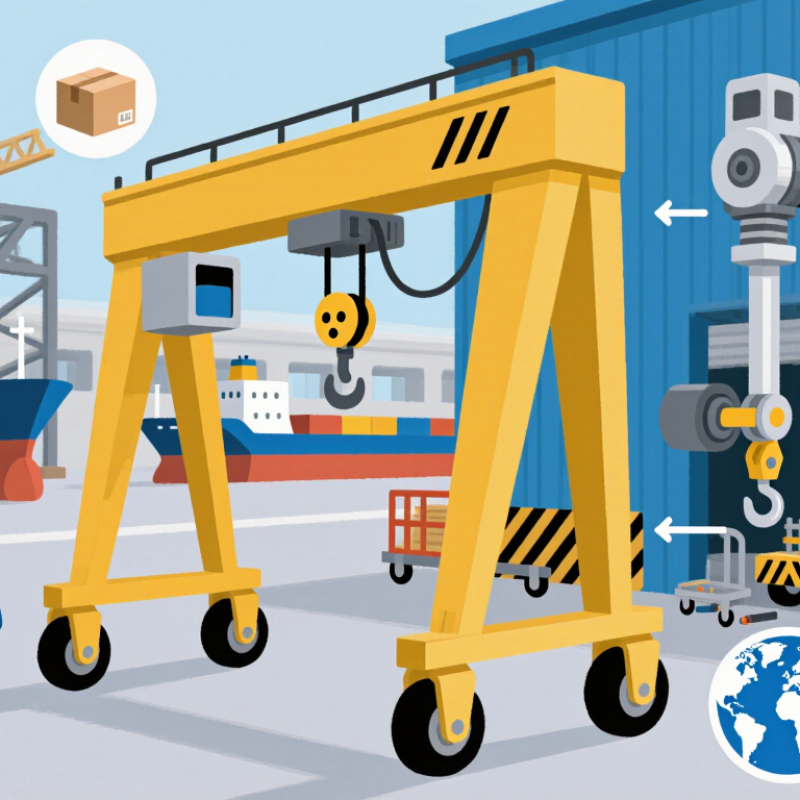
A mobile gantry crane is a freestanding lifting frame that moves on wheels or casters. It usually has two vertical legs, a horizontal beam, a trolley, and a hoist. The crane rolls over a load, then the hoist raises it vertically. The trolley moves the suspended load along the beam. This simple arrangement supports maintenance, warehouse handling, and outdoor installation work. It does not require permanent overhead rails or major building changes.

In practical use, the operator positions the crane on a firm, level surface. The wheels must be locked before lifting begins. Slings or other lifting devices connect the load to the hoist. A centered load reduces swinging and uneven stress. During movement, the load should stay close to the floor.

Inspecting pins, welds, wheels, hooks, and brakes before operation is essential. Small defects can become serious under load. Capacity, lifting height, span, and floor conditions must match the application. A mobile crane is not automatically suitable for every workspace.

For global procurement, buyers should request load charts, material information, inspection records, and operating instructions. Disassembled frames can simplify transport and storage. However, local safety requirements may differ. Confirm compliance before shipment, not after arrival. Measurements can also be misunderstood across suppliers. Clear drawings and written specifications prevent costly revisions. I have found that mobility saves setup time, but it can encourage rushed positioning. That weakness deserves attention during training and daily planning.

Which Lifting Requirements Suit a Mobile Gantry Crane?

Mobile gantry cranes suit lifting tasks that change location, load, or floor layout. They work well where permanent runway installation is costly or impractical. Grand View Research’s 2023 crane market report valued the global market at about USD 41.3 billion in 2022. It also forecasts continued growth through 2030. That growth reflects demand, not automatic suitability. Keep it practical.

Choose this equipment when loads are moderate, lifts are intermittent, and operators need access across a workshop or site. Confirm the rated capacity, span, lifting height, and wheel load before procurement. Measure doorways, aisle widths, floor joints, and turning areas with the crane fully loaded. Uneven floors can affect travel stability. That matters. ISO 4301-1 provides duty classifications, helping buyers match crane usage with expected operating cycles. A crane for occasional maintenance should not be specified like one serving continuous production.

MarketsandMarkets identifies construction and manufacturing as major crane-demand sectors in its global market analysis. Yet a mobile gantry crane may be unsuitable for high-frequency lifting, extreme heights, or restricted overhead clearance. OSHA 1910.179 emphasizes inspection, rated-load controls, and safe operating conditions for gantry equipment. Experienced teams also check brake response, wheel alignment, pendant reach, and emergency access during site trials. I would not rely on catalogue capacity alone. Real floors, unbalanced loads, and rushed positioning often expose the gap between specification and practice. Procurement decisions improve when suppliers receive measured site drawings, lifting schedules, and honest operating assumptions.

What Benefits Does It Offer for Global Procurement?

For global procurement teams, a mobile gantry crane offers practical flexibility when lifting needs change across sites. Its wheeled or rail-guided structure can be repositioned around workshops, warehouses, and temporary installation areas. That reduces dependence on fixed lifting infrastructure and may shorten site preparation. Less civil work. In a real purchasing plan, this can simplify shipping, storage, and redeployment between projects.

The main benefit is not mobility alone. Buyers can match span, lifting height, rated load, wheel type, and power supply to local conditions. A modular design may also reduce container volume, though dimensions must be checked before ordering. Procurement documents should include load charts, inspection records, operating manuals, spare-parts lists, and conformity evidence for the destination market. Clear documentation supports customs review, operator training, and safer commissioning. These details matter.

Mobile equipment can improve utilization when one crane serves several work zones instead of remaining idle. However, transport costs, floor strength, wind exposure, and uneven surfaces can change the financial result. A cheaper quotation is not always cheaper. Experienced buyers request site measurements, duty cycles, maintenance access, and realistic delivery terms before comparing prices. One overlooked issue is local service capability; remote support may not solve a damaged wheel or unavailable control component. That is where planning still needs refinement.

Why Choose a Mobile Gantry Crane for Global Procurement? - What Benefits Does It Offer for Global Procurement?

Procurement Dimension Mobile Gantry Crane Fixed Gantry Crane Overhead Crane Global Procurement Benefit
Typical application Maintenance, assembly, loading, warehousing, and temporary lifting operations Permanent outdoor yards, ports, shipyards, and heavy industrial handling Repetitive lifting along a defined indoor or outdoor runway Suitable for buyers serving multiple facilities or changing project locations
Common rated-capacity range Approximately 0.5–10 metric tonnes for many portable and workshop configurations Commonly from several tonnes to more than 50 metric tonnes, depending on design Commonly from 1 tonne to more than 50 metric tonnes, depending on runway and duty requirements Provides a practical capacity option without automatically requiring permanent heavy infrastructure
Installation requirement Usually self-supporting; normally does not require runway beams or building columns Requires a dedicated structure, stable supporting surfaces, and suitable civil works Requires runway beams, end stops, power supply, and adequate building or support structure Reduces site-preparation scope and can simplify technical approval in rented or temporary facilities
Relocation capability Can be moved between workstations when unloaded and properly secured Normally fixed after installation; relocation requires substantial dismantling and civil work Limited to the installed runway and building layout Improves asset utilization across projects and reduces the need to purchase separate cranes for each site
Typical span and lift height Often available with approximately 2–10 m spans and about 2–6 m lifting heights; configuration-dependent Designed for larger site spans and greater hook heights according to project engineering Designed around building width, runway elevation, and required lifting envelope Offers sufficient working coverage for many workshops while avoiding over-specification
Foundation and civil-work exposure Generally low, provided the floor or ground has adequate load-bearing capacity and levelness Moderate to high; ground conditions, foundations, rails, drainage, and wind loads may require engineering Moderate to high; support columns, runway beams, and building capacity must be verified Lowers exposure to local construction costs, permitting delays, and site-specific civil requirements
Shipping and logistics Usually supplied in modular sections that can be packed for container or general cargo shipment Large structural members may require project cargo, special handling, or on-site assembly Runway components and building interfaces add packaging, coordination, and delivery complexity Modular packing can make international freight planning, customs documentation, and handling easier
Assembly and commissioning Typically involves bolted assembly, trolley or hoist installation, inspection, and functional testing Usually requires engineered installation, alignment, structural inspection, and commissioning Requires runway alignment, electrical integration, limit-switch testing, and commissioning Simpler installation can reduce dependence on specialized local contractors
Power and operating options Electric or manual travel options are available; hoists may use local single-phase or three-phase power Usually uses powered travel and lifting systems designed for continuous site operation Usually electrically powered and integrated with building power and control systems Configuration can be matched to local voltage, frequency, duty cycle, and operating conditions
Maintenance and spare parts Generally accessible components; wheels, brakes, wire rope, hooks, controls, and hoist parts require inspection Maintenance may include rails, large wheels, structural connections, electrical systems, and weather-exposed components Maintenance includes hoist, trolley, runway, collectors, controls, and building-interface components A standardized mobile design can simplify spare-parts planning for multiple international locations
Compliance considerations Requires rated-capacity marking, overload protection where applicable, operating instructions, inspection, and local compliance verification Requires structural, electrical, wind, foundation, and lifting-equipment compliance checks Requires crane, runway, building, electrical, and workplace-safety compliance checks A clearly documented, modular specification supports smoother review by overseas buyers and inspectors
Best-value scenario Intermittent lifting, multiple work areas, short-term projects, leased buildings, and moderate loads High-volume outdoor lifting with a stable layout and long-term utilization Frequent, repetitive lifting within a permanent facility Mobile gantry cranes balance portability, lower infrastructure requirements, and international deployment flexibility

Note: Capacity, span, lift height, power supply, duty classification, wind limits, and transport requirements vary by configuration and destination-country regulations. Final selection should be verified against the applicable lifting-equipment standards, site conditions, and load data.

How Should Buyers Compare Suppliers, Specifications, and Costs?

For global buyers, a mobile gantry crane offers flexible lifting without permanent runway construction. The harder question is supplier comparison. The 2024 Global Cranes Market report by Fortune Business Insights valued the market at approximately USD 36.7 billion in 2023. It also projects strong growth through 2032. That growth increases supplier choice, but not necessarily supplier quality.

Compare suppliers through evidence, not polished brochures. Request load-test certificates, material records, welding procedures, inspection reports, and documented warranty terms. Check whether the manufacturer supports the destination’s applicable standards, such as ISO 4301, EN 13157, or ASME B30.17. A useful supplier should explain wheel-lock design, beam deflection, brake performance, and spare-part availability. Ask for a video of a similar crane under inspection. Small details matter. Sometimes, the cheapest supplier avoids the hardest questions.

Specifications must reflect the real working scene. Define safe working load, lifting height, span, floor condition, wheel type, duty cycle, and indoor or outdoor exposure. A 2-ton crane may suit a maintenance bay but fail operationally with frequent side movement. Compare total landed cost, including packing, freight, duties, installation, training, testing, and future repairs. The International Labour Organization emphasizes systematic risk assessment for lifting operations. Buyers should therefore price safety controls, not treat them as optional extras. I would not assume the lowest quotation is the best value; that assumption is often wrong.

Why Choose a Mobile Gantry Crane for Global Procurement?

How should buyers compare suppliers, specifications, and costs?

This 100-point screening model prioritizes specification fit, safety compliance, total landed cost, delivery reliability, and after-sales support. Buyers should confirm load capacity, span, lifting height, applicable standards, freight charges, installation requirements, spare-parts availability, and warranty terms before requesting comparable quotations.

What Standards and Delivery Factors Affect International Purchasing?

A mobile gantry crane can simplify global procurement when lifting locations change. Its casters, adjustable span, and modular beams reduce dependence on fixed infrastructure. However, international buyers should verify standards before comparing prices.

ISO 12100 requires documented machinery risk assessment and risk reduction. EN 13001 addresses crane design, load combinations, and structural safety. ASME B30.17 provides guidance for gantry crane operation and inspection. Local acceptance may still differ. That gap causes delays.

Delivery planning matters as much as engineering. UNCTAD’s Review of Maritime Transport 2023 reports that over 80% of world merchandise trade by volume moves by sea. Therefore, packed dimensions, container compatibility, port access, and corrosion protection deserve early review.

The World Bank Logistics Performance Index 2023 also shows major differences in customs efficiency and delivery reliability between countries. A crane that clears export procedures quickly may wait weeks at destination. Small paperwork errors can become expensive.

Tips:

  • Request a complete technical file, including drawings, load charts, test certificates, manuals, and spare-part lists.
  • Confirm whether the quoted price includes export packaging, insurance, inland transport, duties, and installation support.
  • Use Incoterms 2020 carefully.
  • Check wheel locks and floor loading with the site team. This is often overlooked.
  • A practical trial assembly can reveal missing bolts, unclear labels, or awkward handling points before shipment.
  • Do not assume one certificate satisfies every authority; confirm the destination rules in writing.