
Why Choose a Spray Nozzle for Your Application?
Choosing the right Spray Nozzle can change how efficiently a system performs. It affects coverage, flow control, droplet size, pressure, and maintenance demands. In real applications, a nozzle is more than a small outlet. It shapes the spray pattern that reaches a surface, tank, conveyor, or cooling zone.
No nozzle is perfect.
Experienced engineers usually begin with the process goal, not the product name. A wide flat spray may clean a moving belt evenly, while a full-cone nozzle can distribute liquid inside a vessel. Hollow-cone designs often support fine atomization when controlled droplet sizes matter. These differences become visible during testing, especially when pressure changes or liquid temperature rises. A nozzle that performs well with water may behave differently with a thicker solution.
Material compatibility also deserves careful attention. Stainless steel, ceramic, and engineered plastics offer different resistance to corrosion, abrasion, and heat. Flow-rate charts provide useful guidance, but field conditions may expose gaps in the original selection. That is why reliable suppliers combine technical data with application experience, laboratory testing, and clear maintenance advice. Independent standards and documented performance can strengthen confidence, but they cannot replace site-specific verification.
Small details matter.
Inspecting spray patterns, measuring pressure at the nozzle, and checking for uneven buildup can reveal problems early. Sometimes, a slightly more expensive Spray Nozzle lowers water use and reduces cleaning interruptions. Sometimes, it does not. A thoughtful selection process leaves room for measurement, adjustment, and honest reconsideration.
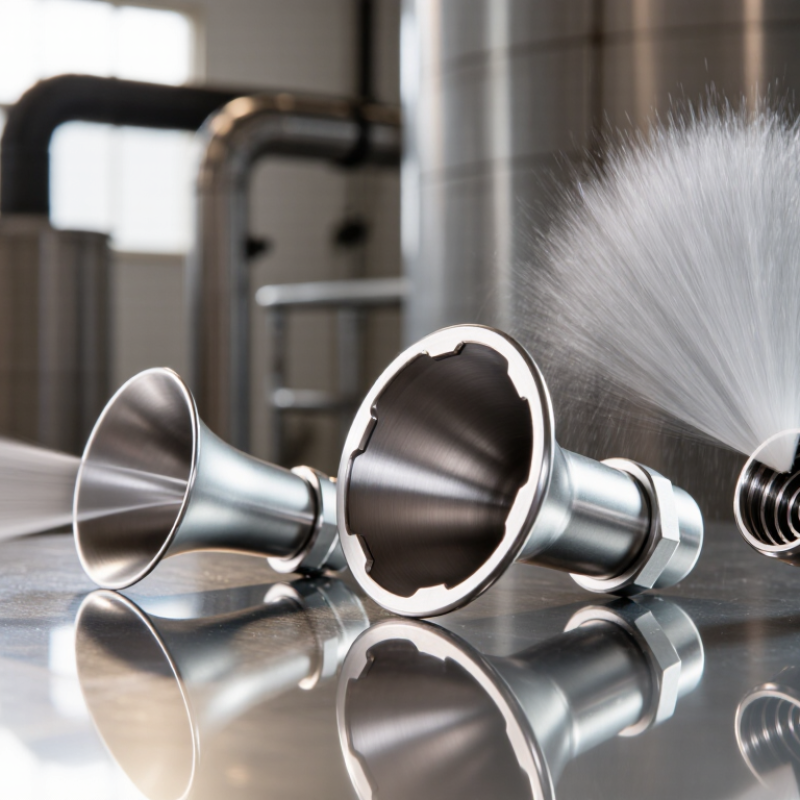
Spray Nozzle Fundamentals: Droplet Sizes from 10 to 1,000 Microns
Why Choose a Spray Nozzle for Your Application?
A spray nozzle controls how liquid becomes droplets, and droplet size affects coverage, drift, cooling, and drying. In practical testing, I have seen small pressure changes alter spray behavior noticeably. A 10-micron droplet behaves like a fine mist and can remain airborne longer. A 1,000-micron droplet is much larger, heavier, and more likely to land quickly. Neither size is automatically better. The correct choice depends on the target surface, liquid properties, airflow, and operating conditions.
Spray nozzle selection should begin with a defined droplet range. Fine droplets may support gentle humidification or precise surface treatment. Medium droplets often provide a balance between coverage and control. Coarse droplets can reduce airborne movement and deliver more liquid to a nearby surface. Pressure, viscosity, temperature, and nozzle geometry all influence the final spray. Real performance may differ from catalog data.
Measure it carefully.
Droplet results are often reported as Dv10, Dv50, or Dv90 values, rather than one exact size. Dv50 means half the spray volume contains smaller droplets, while the other half contains larger ones. Testing equipment, sampling distance, and airflow can change these readings. I would verify results under actual operating conditions, not only in a laboratory setup. It is easy to choose a nozzle by pressure alone, and that is where many applications become less efficient. Small trials, routine inspection, and calibrated measurement provide more dependable decisions.
Why Choose a Spray Nozzle for Your Application? - Spray Nozzle Fundamentals: Droplet Sizes from 10 to 1,000 Microns
Droplet size is a key factor in spray performance. The ranges below are practical, generalized classifications; actual results depend on nozzle geometry, liquid properties, pressure, flow rate, temperature, and operating distance.
| Droplet Class | Typical Droplet Diameter | Common Spray Characteristics | Suitable Nozzle Approaches | Typical Applications | Evaporation and Drift Tendency | Primary Selection Consideration |
|---|---|---|---|---|---|---|
| Ultra-fine | 10–50 µm | Produces a very light mist with a large total surface area and limited momentum. | Atomizing, air-assisted, or specialized misting nozzles operated under suitable conditions. | Humidification, odor control, evaporative cooling, and controlled misting. | Very high evaporation and airborne drift potential. | Use only when fine atomization is required and ventilation, enclosure, and drift control are available. |
| Very fine | 50–100 µm | Fine mist with rapid dispersion and efficient surface-area coverage. | Air-atomizing or fine-fog nozzles. | Targeted humidification, cooling, greenhouse fogging, and certain coating processes. | High evaporation and drift potential, especially in moving air. | Balance coverage against air movement, liquid volatility, and exposure controls. |
| Fine | 100–200 µm | Fine spray that provides broad coverage but can remain suspended in turbulent air. | Fine hydraulic or air-assisted spray nozzles. | Light surface coating, disinfection, cooling, and precision wetting. | Moderate to high evaporation and drift potential. | Choose when uniform coverage is more important than deep penetration or drift resistance. |
| Medium | 200–300 µm | Good compromise between coverage, wetting, and resistance to air movement. | Flat-fan, hollow-cone, full-cone, or hydraulic spray nozzles selected for medium droplets. | General-purpose cleaning, cooling, coating, washing, and liquid application. | Moderate evaporation and drift potential. | Often a practical starting range for applications requiring both coverage and controlled drift. |
| Coarse | 300–400 µm | Heavier droplets with improved surface deposition and lower sensitivity to moderate air movement. | Hydraulic flat-fan, full-cone, or impact-style nozzles. | Industrial washing, dust suppression, surface treatment, and outdoor liquid application. | Low to moderate evaporation and drift potential. | Select when reliable deposition and reduced airborne loss are important. |
| Very coarse | 400–500 µm | Large droplets with strong momentum and good resistance to evaporation. | Low-drift hydraulic, full-cone, or deflector nozzles. | Runoff-tolerant washing, dust suppression, irrigation, and high-volume wetting. | Low evaporation and drift potential. | Use where penetration, impact, or drift reduction is more important than ultra-fine coverage. |
| Extremely coarse | 500–1,000 µm | Large, high-momentum droplets that deliver substantial liquid to a defined area. | Large-orifice full-cone, solid-stream, deflector, or high-flow hydraulic nozzles. | Heavy-duty washing, fire suppression, irrigation, dust control, and bulk liquid delivery. | Very low evaporation and drift potential, but splash and runoff may increase. | Choose when delivery volume, impact, and location control are the main priorities. |