A rolling gantry crane can turn a crowded workshop corner into a practical lifting station. Its wheels move the frame between work areas, while adjustable beams and hoists help handle loads that fixed equipment cannot reach. Yet mobility alone does not make every model suitable. Floor condition, load capacity, clearance, and how often the crane must travel all affect the choice.
This guide compares the top rolling gantry crane types in 2026, from compact aluminum frames to heavy-duty steel designs and adjustable-height models. It will examine where each type works best, what trade-offs buyers should expect, and which details deserve a closer look. A small caster may look insignificant. Under load, it matters. So does the surface beneath it; uneven concrete can make movement less predictable. Specifications are useful, but they do not tell the whole story.
A trustworthy expert quotation cannot be added without a verifiable source. Rather than inventing a person or statement, this introduction focuses on practical selection factors. That restraint matters: a crane choice affects daily workflow, equipment condition, and operator safety. Some comparisons may still depend on the actual site. No single model fits every shop.
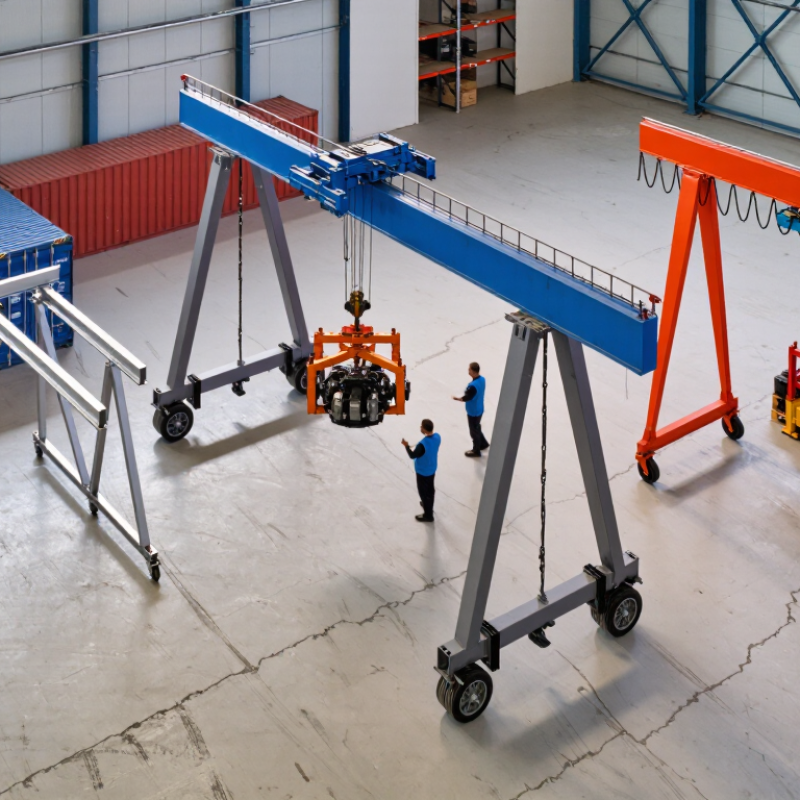
What Are the Top Rolling Gantry Crane Types in 2026?
How Rolling Gantry Cranes Are Classified
Rolling gantry cranes are classified by how they move, how their frames adjust, and how loads are lifted. Mobility is the clearest distinction. Some models roll on lockable casters across a smooth workshop floor; others travel along fixed rails for a repeatable route. A small caster-mounted frame may suit occasional equipment positioning, while rail travel can offer steadier movement in a dedicated work area. Floors matter more than they may seem.
Frame design provides another useful category. Fixed-height gantries have a set clearance, which can make setup straightforward. Adjustable-height models use telescoping legs or pinned sections to fit different workspaces and load heights. Adjustment takes time, and every locking point needs careful inspection. Not glamorous, but important.
Lifting systems also separate one type from another. Manual chain hoists are common for lighter or intermittent tasks, while electric hoists reduce operator effort during frequent lifts. Classification should also consider rated capacity, span, and the shape of the load. A long beam or awkward machine can behave differently from a compact, evenly balanced component. Check the crane’s documentation and the actual floor conditions before selecting a type; a category label alone does not confirm that a unit suits a particular job.
Rolling gantry cranes are commonly classified by frame material and height adjustment. The chart shows representative rated-capacity examples; actual capacities vary by design, span, and manufacturer.
Aluminum models are generally selected for portability, while steel models suit heavier-duty lifting. Adjustable and telescoping designs allow the working height to be changed; always verify the crane’s rated load and operating limits.
Portable and light-duty rolling gantry cranes suit workshops, maintenance bays, and small production areas where fixed lifting equipment is impractical. Their wheeled frames can move between workstations, while adjustable legs and beam heights help accommodate varied loads. Compact does not mean casual. Check the rated capacity on the crane’s load chart, and include the hoist, trolley, and rigging in the lifted load. A steel frame may feel reassuring, but uneven floors or unlocked casters can still make a lift unstable.
Choose a capacity with room for real working conditions, not just the heaviest item listed on paper. Verify floor condition, wheel locks, beam deflection limits, and clearance before moving a suspended load. OSHA’s overhead and gantry crane standard specifies test loads of 100% to 125% of rated capacity for applicable load tests (29 CFR 1910.179(k)(2)); confirm the requirements for the specific crane and workplace. This is a useful benchmark, not a substitute for the manufacturer’s instructions or a competent inspection. Small oversights matter. I would also check how the crane behaves while rolling unloaded, since a tight doorway or floor joint can expose handling problems before the first lift.
Adjustable-height rolling gantry cranes suit workshops where loads vary and floor space is shared. Operators can set the beam higher for tall equipment or lower for safer access during assembly. Height adjustment may use pinned legs, screw mechanisms, or powered systems; each requires a clear procedure and regular inspection. Check that the crane is level before lifting. Small errors matter.
Telescoping models add another useful adjustment: the beam extends or retracts to match different load widths. That can reduce awkward sling angles when moving machinery between work areas. For example, a maintenance team might shorten the span near a narrow machine bay, then extend it over a wider assembly table. The added range is practical, but it does not automatically mean greater lifting capacity. Capacity can change with span and configuration, so consult the load chart and manufacturer’s instructions for the exact setup.
Before choosing a crane, measure doorways, ceiling obstructions, travel paths, and the widest expected load. Consider how often workers will change height or span; frequent adjustments can slow a shift if controls are difficult to reach. Inspect locking pins, telescoping sections, wheels, and brakes for wear or looseness. A detail people sometimes overlook: a smooth concrete floor helps, but debris can still stop a caster. These cranes offer flexibility, though the adjustment mechanisms add parts that need attention.
Powered and heavy-duty rolling gantry cranes suit jobs where fixed overhead rails are impractical. Powered models use electric travel drives to move along floor-level tracks or prepared paths, reducing the effort of repositioning loads across a workshop. Heavy-duty versions prioritize rated capacity, stiff beams, and stable end frames for lifting large machinery or steel assemblies. Capacity alone is not enough: wheel loads, floor condition, span, headroom, and travel distance all affect a safe selection. OSHA’s 2023 crane standard guidance emphasizes following manufacturer procedures and staying within rated capacity; a moving load can still swing or shift.
The U.S. Bureau of Labor Statistics recorded 297 fatal occupational injuries involving cranes from 2011 through 2017. That figure covers varied crane work, not rolling gantry cranes alone, but it underscores why careful planning matters. A powered unit may improve control, yet it cannot correct an uneven floor or poor load balance. Real sites are messier. Check the route, brakes, controls, and emergency stop before each shift, and verify the load’s center of gravity before lifting.
Tips: Match the crane’s rated capacity to the heaviest planned lift, not the average one. Keep travel speed low near doorways and turns. If the floor has cracks, slopes, or soft patches, pause and reassess; specifications on paper do not reveal every site condition.
| Rolling Gantry Crane Type | Typical Rated Capacity | Typical Span | Typical Lift Height | Travel Method | Typical Power Arrangement | Best-Suited Applications | Main Advantages | Key Selection Considerations |
|---|---|---|---|---|---|---|---|---|
| Manual Portable Rolling Gantry Crane | 0.5–5 metric tonnes | 2–6 m | 2–4 m | Manual push or pull on lockable casters | Manual chain hoist or low-voltage electric hoist | Maintenance areas, workshops, machine installation, and occasional lifting | Low operating cost, compact footprint, and easy relocation | Floor condition, caster capacity, stability during movement, and whether the crane may be moved with a suspended load |
| Powered Mobile Rolling Gantry Crane | 2–20 metric tonnes | 3–10 m | 3–8 m | Motor-driven end trucks or powered wheels | Electric drive with pendant, radio, or integrated control system | Production lines, warehouses, shipyards, and repeated load-transfer operations | Reduced manual effort, smoother travel, and better control over frequent movements | Travel speed, wheel load, battery or cable power supply, braking, and indoor or outdoor operating conditions |
| Adjustable-Height Rolling Gantry Crane | 1–10 metric tonnes | 2–8 m | 2.5–6 m adjustable | Manual or powered travel, depending on configuration | Manual, electric, or hydraulic height adjustment with an electric hoist | Facilities with different work heights, tooling changes, and flexible maintenance stations | Adaptable clearance and improved use of available workspace | Height-adjustment locking system, synchronized lifting, side-load prevention, and required setup time |
| Telescopic or Folding Rolling Gantry Crane | 0.5–5 metric tonnes | 2–6 m | 2–5 m | Manual travel on casters or compact powered wheels | Usually manual handling with an electric or chain hoist | Service bays, rental fleets, construction sites, and locations with limited storage space | Compact transport and storage, fast deployment, and flexible configuration | Maximum capacity at each extension position, locking pins, folded dimensions, and setup procedures |
| Heavy-Duty Powered Rolling Gantry Crane | 20–100+ metric tonnes | 6–20 m or more | 6–15 m or more | Powered travel through geared end trucks or multi-wheel drive systems | Three-phase electric motors, variable-speed drives, and an electric wire-rope hoist | Steel fabrication, precast concrete, heavy equipment assembly, shipbuilding, and plant logistics | High load capacity, controlled acceleration, long travel capability, and suitability for demanding duty cycles | Runway or floor bearing capacity, wheel loads, wind forces, structural deflection, duty classification, emergency stops, and load testing |
| Outdoor All-Terrain Rolling Gantry Crane | 5–50 metric tonnes | 4–15 m | 4–12 m | Powered rubber-tired wheels or rail-guided travel | Electric, battery-electric, or diesel-electric drive system | Outdoor yards, infrastructure projects, ports, modular construction, and uneven-site material handling | Designed for longer travel routes and changing outdoor work locations | Ground compaction, gradient, weather protection, wind limits, tire selection, drainage, and outdoor electrical safety |
| Data note: The figures above are typical engineering ranges for comparison purposes. Actual capacity, span, lift height, travel speed, wheel loads, duty class, and operating limits must be confirmed through a site-specific design and the applicable local crane safety requirements. A rolling gantry crane should not be moved with a suspended load unless the manufacturer and the engineered operating procedure explicitly permit it. | ||||||||
Rolling gantry cranes differ in height adjustment, frame material, and mobility. A fixed-height steel gantry suits repeat lifting in one work zone, such as moving a motor between a workbench and a service bay. Its rigid frame can feel reassuring under load, but it may not clear tall equipment. Measure the load’s full lifting height, including the hoist and sling, before choosing.
Adjustable-height models help when loads or workstations vary. Check how the legs lock; pins should seat fully, and the frame must remain level. Aluminum gantries are easier to reposition by hand, while steel frames are often selected for heavier-duty tasks. Neither material alone determines safe capacity. The complete crane’s rated load, span, hoist, and floor conditions matter.
For tight storage areas, folding gantries reduce the footprint when not in use. They can take longer to set up, and that trade-off is easy to underestimate. Before comparing types, note the load’s weight and dimensions, aisle width, floor slope, and travel distance. Small caster wheels may struggle over thresholds. Lock the wheels during lifting, keep the load centered, and avoid moving a suspended load unless the crane is specifically designed for that operation. When details are uncertain, consult the crane documentation or a qualified lifting professional.