
Why Choose a 2 Ton Gantry Crane for Global Buying?
Why Choose a 2 Ton Gantry Crane for Global Buying?
Global buyers are reassessing compact lifting equipment. A 2 ton gantry crane can serve workshops, warehouses, maintenance bays, and construction sites. It offers useful capacity without demanding a permanent overhead structure. That flexibility matters where floor space, building height, or installation time remains limited.
Fortune Business Insights valued the global crane market at approximately USD 34.12 billion in 2023. Its report projects continued growth through 2032. Mordor Intelligence also forecasts expansion, although its market boundaries and figures differ. These reports cover wider crane categories, not only the 2 ton gantry crane segment. That limitation deserves attention. Market data can guide purchasing, but it cannot replace a site assessment.
Ross Moloney, former CEO of the Lifting Equipment Engineers Association, has emphasized, “Competence is at the heart of safe lifting.” His message applies directly to international procurement. Buyers should verify rated capacity, wheel loading, beam dimensions, hoist compatibility, braking performance, and inspection records. A two-ton rating does not mean every configuration safely lifts two tons. Load center, floor condition, wind exposure, and travel speed can change the decision. Picture a steel frame crossing a concrete floor with a suspended motor beneath it. Small design errors become expensive quickly.
A sound global purchase compares documentation, service support, spare-part access, and applicable standards. Price still matters. It should not dominate the evaluation. Manufacturers should provide traceable test certificates and clear operating instructions. The better choice is not always the cheapest crane. It is the crane that remains predictable after delivery, installation, and years of use.
What Is a 2 Ton Gantry Crane?
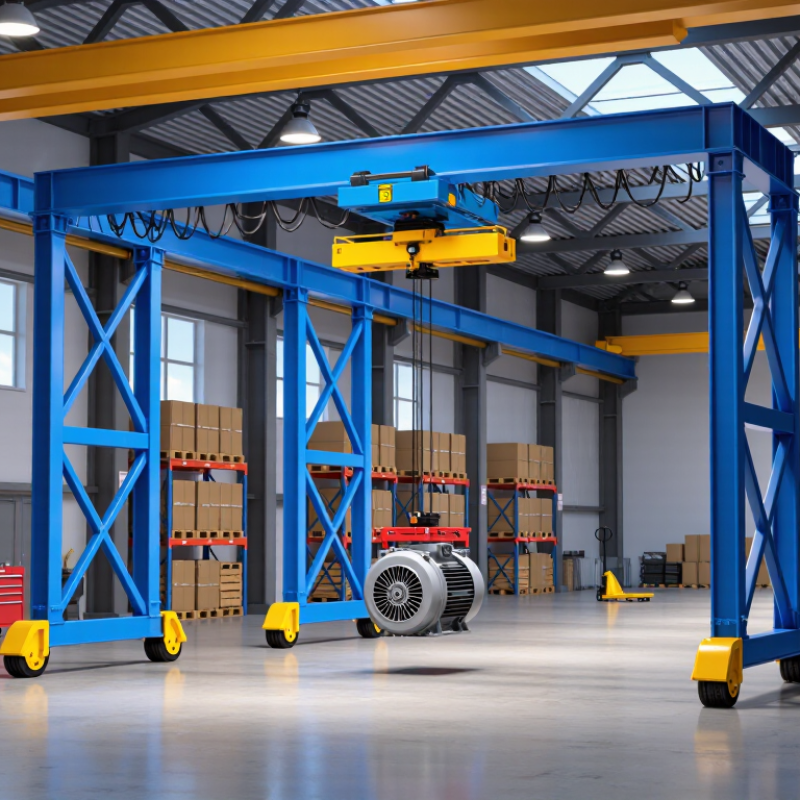
A 2 ton gantry crane is a movable lifting system rated to handle loads up to 2,000 kilograms. It usually has two vertical legs, a horizontal beam, wheels, and a hoist or trolley. The legs support the beam while the hoist raises and moves materials across the working area. Unlike an overhead crane, it does not require a permanent building runway. The runway is absent.
This design suits workshops, warehouses, maintenance areas, and outdoor loading zones. A typical unit may lift an electric motor, steel component, machine part, or packed crate. Its actual capacity depends on the beam span, lifting height, wheel design, and load position. A longer span can reduce stability if the structure is poorly engineered. That detail is often overlooked.
When evaluating one for global purchasing, buyers should check rated load charts, brake performance, wheel locks, weld quality, and inspection records. The 2 ton rating is not permission to lift every 2 ton object in every condition. Uneven floors, sudden movement, wind, and off-center loads can create dangerous side forces. In practical use, operators may also need adjustable legs or a low-clearance design. Specifications can look complete, yet installation space may expose a problem later. Clear manuals, replacement-part information, and conformity documents help confirm reliability across different operating environments.
Why Choose a 2 Ton Gantry Crane for Global Buying? - What Is a 2 Ton Gantry Crane?
| Data Dimension | Typical Information for a 2 Ton Gantry Crane | Global Buying Relevance |
|---|---|---|
| Definition | A gantry crane is a lifting system supported by two or more upright legs that move on wheels, rails, or a fixed runway. A 2 ton model has a rated lifting capacity of 2 metric tonnes, equal to approximately 2,000 kg or 4,409 lb. | The capacity is easy to compare internationally when the buyer confirms whether the supplier uses metric tonnes or US short tons. |
| Rated Load Capacity | Maximum rated load: 2,000 kg under the specified operating conditions. The crane should not be loaded beyond its rated capacity. | Suitable for many machine parts, steel components, maintenance tasks, molds, motors, and packaged industrial materials. |
| Common Span Range | Approximately 3 to 10 m for many light-duty and workshop configurations. The practical range depends on structural design, deflection limits, and the required lifting height. | The span should match the building width, work area, container dimensions, or outdoor handling zone without creating unnecessary structural cost. |
| Typical Lifting Height | Common lifting heights range from about 3 to 6 m, while custom designs may provide greater height when the legs, runway, and stability requirements allow it. | Accurate headroom and hook-height requirements help prevent interference with doors, roof structures, stored goods, and production equipment. |
| Main Crane Configuration | Usually includes a steel bridge beam, two supporting legs, end carriages or wheels, a trolley, a hoist, electrical controls, and safety devices. | A modular configuration can simplify transportation, assembly, replacement of parts, and installation at different locations. |
| Hoist Type | Common options include electric wire-rope hoists and electric chain hoists. Manual hoists may be used where lifting frequency and speed requirements are low. | The choice affects lifting speed, maintenance, power requirements, noise, and suitability for indoor or outdoor work. |
| Travel Arrangement | Portable models may travel on rubber wheels, while heavier or more frequently used models may run on rails or a prepared track. | Wheel-based designs offer flexibility for multiple work areas; rail-mounted designs generally provide more controlled and repeatable travel. |
| Indoor and Outdoor Use | Indoor use is common in workshops, warehouses, and maintenance areas. Outdoor use requires suitable corrosion protection, weather-resistant electrical components, and an appropriate foundation or travel surface. | Environmental conditions can significantly affect coating selection, enclosure ratings, inspection frequency, and service life. |
| Power Supply | Electric versions are commonly specified for three-phase industrial power, but voltage, frequency, control voltage, and phase requirements vary by country and installation site. | The buyer should confirm the local electrical standard before ordering to avoid transformer changes, rewiring, or commissioning delays. |
| Operating Duty | A 2 ton crane can be configured for light, medium, or more frequent service. Duty classification depends on load spectrum, lifting cycles, operating hours, and travel frequency—not capacity alone. | Providing the expected daily cycles and average load helps prevent selecting an under-designed or unnecessarily expensive crane. |
| Safety Features | Typical features include an emergency stop, upper and lower hoist limit switches, overload protection, travel limit devices, brakes, hook safety latches, and warning signals where required. | Safety equipment should be selected and verified according to the regulations applicable at the installation site. |
| Relevant Design Standards | Applicable requirements may come from national or regional regulations and recognized crane standards. Structural design, electrical systems, lifting components, and inspections may be governed by different rules. | The purchaser should identify the destination-country requirements before finalizing drawings, testing, documentation, and certification. |
| Typical Applications | Workshop maintenance, small-scale manufacturing, warehouse handling, equipment installation, construction support, agricultural facilities, and loading or unloading tasks. | The 2 ton capacity is often large enough for routine industrial handling while remaining suitable for smaller workspaces. |
| Installation Requirements | Requirements may include a level floor, adequate ground bearing capacity, sufficient clearance, stable travel paths, correct anchoring where applicable, and access to electrical power. | Early site verification reduces installation risks and helps the buyer estimate civil works, assembly labor, and delivery access. |
| Transport and Assembly | Many 2 ton gantry cranes can be shipped in separated components, such as the beam, legs, trolley, hoist, controls, and hardware. Actual package size and weight depend on the design. | A disassembled structure can reduce container-space requirements and make delivery to international destinations more practical. |
| Maintenance Needs | Routine maintenance generally includes inspecting hooks, wire ropes or chains, brakes, wheels, electrical cables, limit switches, bolts, welds, lubrication points, and structural components. | Standardized components, accessible spare parts, clear manuals, and local service capability are important for long-term global operation. |
| Key Information to Request Before Purchase | Request a general arrangement drawing, load chart, span, lifting height, travel length, duty classification, power supply, wheel load, structural material details, safety device list, inspection documents, spare-parts list, and installation instructions. | Complete technical information makes quotations easier to compare and helps ensure that the crane is compatible with the destination site. |
Note: Dimensions, speeds, duty classifications, electrical specifications, and safety requirements vary by design, application, installation environment, and destination-country regulations. Final specifications should be confirmed through an approved engineering design and site assessment.
Related Posts
-
2026 Best 2 Ton Gantry Crane Buying Guide and Tips?
-
Top 10 Overhead Gantry Crane Benefits and Applications You Should Know
-

Top 10 Central Crane Suppliers in China for Global Buyers?
-
2026 Best Boom Truck Crane Models for Your Construction Needs?
-
2026 Best 1 Ton Overhead Crane for Global Buyers?
-
How to Choose the Right Grove Crane for Global Projects?